














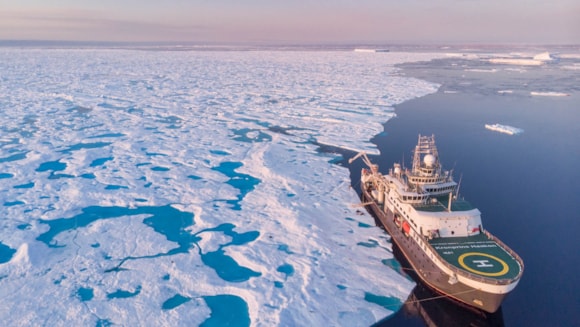
The scale of sea ice loss has led to a sharp fall in nutrient levels, with serious consequences for the ecosystem.
Vast shallow regions of the Arctic Ocean have been exposed to sunlight so consistently they have been irreversibly altered.
These areas were once covered by sea ice, preventing solar radiation from penetrating beneath the water. Without this protection, the chemical balance of the shallows has been changed in what scientists now believe is an irreversible reaction.
Research has revealed that levels of a key nutrient have now fallen so low that populations of plankton, fish, seabirds, and marine mammals are all affected. The assessment casts the vulnerability and fragility of ecosystems to relatively small atmospheric and environmental changes.
Led by the University of Edinburgh, the team used Arctic Ocean data spanning a 20-year-period, with samples taken from the Fram Strait. This is the main gateway to the Atlantic through which Arctic waters flow. From 2009 onwards, nitrate levels in the sea have been falling sharply, dropping in tandem with sea ice cover.
‘The changes we report suggest that the Arctic Ocean ecosystem passed a tipping point around 2009. How this change cascades through the food chain needs to closely monitored as this has profound implications for us, including on commercial fishing in the North Atlantic Ocean,’ said Professor Raja Ganeshram, of the University of Edinburgh’s School of GeoSciences,
As a result, the natural process that sees nitrates into nitrogen gas — benthic denitrification — has increased. One of the most significant repercussions of this would mean the Arctic Ocean now only capable of supporting smaller plankton types, meaning there is less food at the bottom of the chain.
‘For years, sea-ice loss in the Arctic Ocean was expected to increase phytoplankton growth because more sunlight could reach surface waters. Our findings suggest that this relationship has changed… with far-reaching consequences for marine ecosystems, food chains and the role of the Arctic in the Earth’s climate,’ Marta Santos-García, a PhD student in the University of Edinburgh’s School of GeoSciences, who co-led the study.
Image: Norwegian Polar Institute
More on Biodiversity & Climate Change:
2026 breaks all-time May temperature records with ‘tropical night’
Honeybees enlisted as citizen scientists to map UK’s floral landscape
Woodland project could shape future tree-planting across the UK