









The European Commission have found that more than a third of clothing labels in Europe are inaccurate,
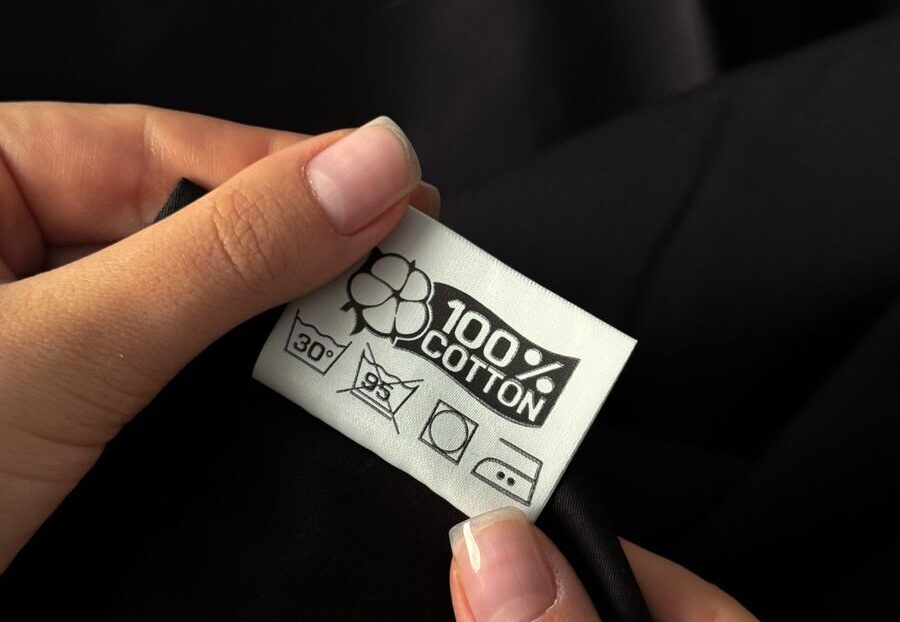
Out of 132 items tested, 49 (37%) were mislabelled when it came to the fibres they are made from, despite this being one of the few details clothing companies are legally required to provide.
At the same time, there is still no requirement in the EU or UK for clothing labels to disclose PFAS, a group of long-lasting ‘forever chemicals’ linked to environmental harm and potential health risks. This means shoppers can’t fully trust even basic information about what their clothes contain, and have no visibility at all on other chemicals used in production.
Campaigners say this creates a double problem: misleading information on labels, and a lack of transparency about potentially harmful substances.
Eco Age’s Forever Label campaign is calling for that to change, urging mandatory PFAS disclosure on clothing and textiles sold in both the EU and UK. The proposal would require this information to appear on physical labels and online product listings.
France has already introduced a ban on PFAS in clothing, Denmark’s ban comes into force in July, and the European Chemicals Agency has recently closed consultation on a wider restriction. In the UK, MPs have also recommended a phased ban on non-essential uses of PFAS in consumer goods from 2027.
The testing process, coordinated by the European Commission’s Directorate-General for Internal Market, Industry, Entrepreneurship and SMEs (DG GROW), sampled everything from baby clothes to activewear, scarves to nightwear. Products were bought both online and in physical stores, then sent to an accredited laboratory in Italy for forensic testing.
Scarves were found to perform worst, with four in five failing to accurately declare their contents. Tops followed closely, with a 54% failure rate. Even baby clothing failed in a quarter of cases.
The investigators identified three main types of deception. Some labels correctly named the fibres but got the percentages wrong. Others swapped expensive natural fibres for cheaper alternatives without telling the consumer. And on some products, fibres were simply misnamed entirely.
The problem is particularly acute for items claiming to be blends of natural and artificial fibres, which had a 64% failure rate. Products labelled as 100% single natural fibre fared better, but still 15% were found to be non-compliant.
DG GROW Policy Officer, Vanessa Capurso said: ‘Consumers and businesses need to know that the labels on the garments they buy give a true picture of the fibre composition of those garments. Market surveillance campaigns help ensure consumers get what they pay for and protect businesses from unfair competition.
John Higginson, CEO of Eco Age said: ‘The Commission’s own testing has confirmed what shoppers have long suspected. More than a third of clothing labels do not reflect what is actually in the garment, and that is on fibre composition alone, which is the one thing the label is legally required to do.
‘The bigger problem is what the label does not have to mention at all. There is no requirement anywhere in the EU or UK to disclose PFAS, the forever chemicals linked to long-term health and environmental harm, on a clothing label. So consumers are being misled on what is in their clothes, and kept in the dark on what they should be worried about. The system is failing twice over.
‘This is exactly the transparency gap The Forever Label campaign is working to close. If a label cannot reliably tell you whether a jumper is cotton or polyester, it is not a credible basis for trusting that a school uniform or raincoat is safe.’
Patrick Strumpf, CEO, Haelixa who offer a DNA-based authenticity service added: ‘A 37% failure rate is not an outlier. It is what happens when an entire system relies on documentation to describe physical reality. Labels and certificates record what was claimed at some point upstream. They do not confirm what is actually in the garment a consumer buys.
‘The detail that should concern the industry most is the blended fabrics. Almost two thirds of natural and artificial blends failed testing. Blends are exactly where substitution is easiest to hide, because a small change in composition is invisible to the eye and rarely challenged on paper. This is not a labelling error. It is a verification gap.
‘There is also a circularity cost that is easy to miss. You cannot recycle what you cannot identify. If a garment’s stated fibre content is wrong, it enters the recycling stream under false information, and the output is compromised. Accurate fibre data is a prerequisite for circular textiles, not an optional extra.’