


















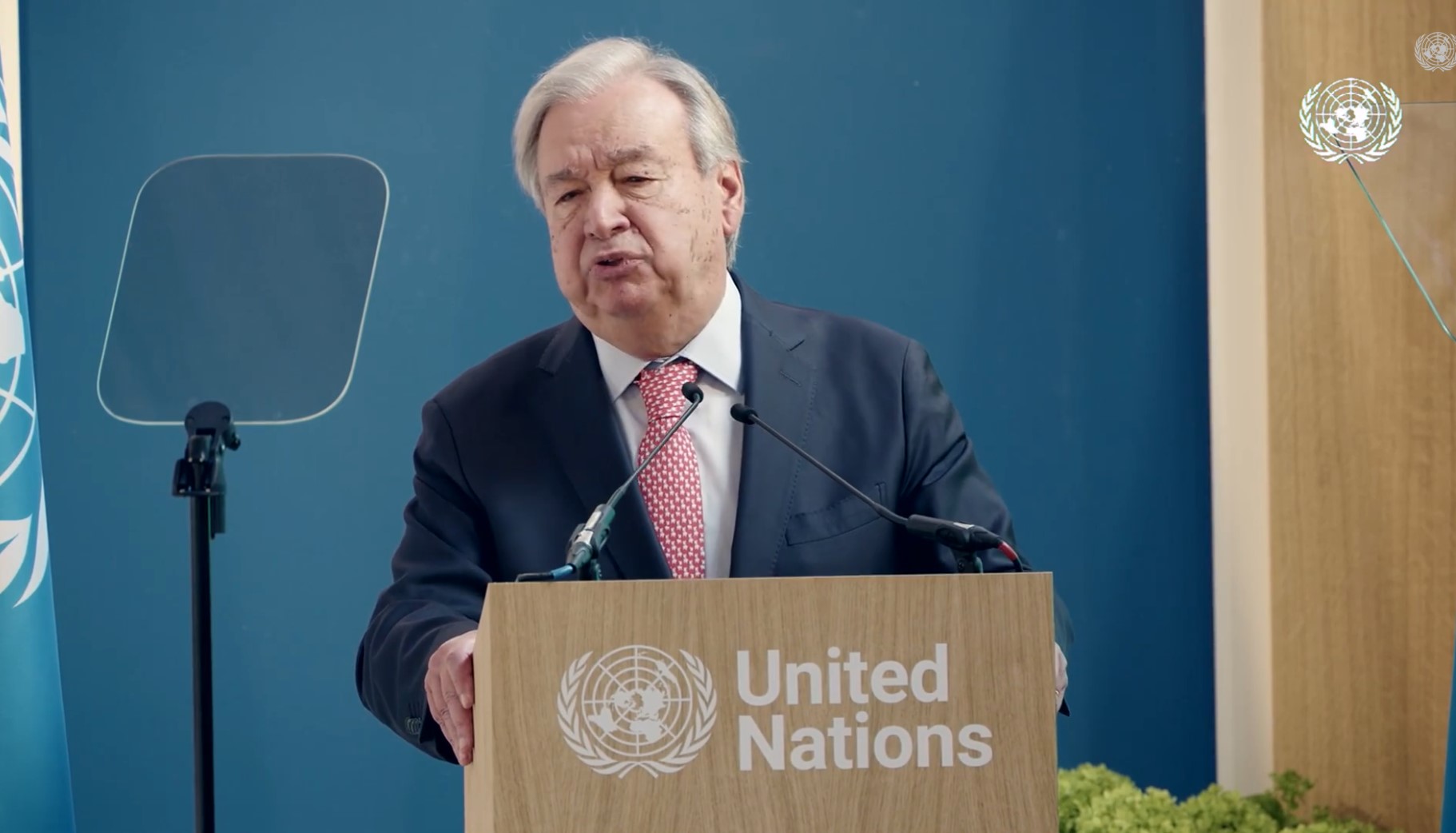
United Nations Secretary-General António Guterres has warned that the world is caught between a worsening climate emergency and a deepening energy crisis, and that both have the same root cause: fossil fuels.
Speaking at London Climate Action Week, yesterday, Guterres delivered an impassioned address in which he called on world leaders, governments, and the private sector to accelerate the transition to clean energy, slash methane emissions, and ensure that artificial intelligence companies come clean about their environmental footprint.
Drawing on a literary flourish, the Secretary-General described the situation as ‘a tale of two crises’, invoking the spirit of Charles Dickens, whose work was set in the very city hosting the speech. ‘London isn’t just calling,’ he said, ‘it’s cooking,’ as the capital sweltered through one of its hottest days of the year.
Guterres warned that the eleven hottest years ever recorded have all occurred in recent memory, and that the El Niño weather phenomenon risked pushing temperatures to catastrophic new heights. He cautioned that the world’s tipping points — from collapsing coral reefs to melting ice sheets in Greenland and West Antarctica — were ‘far closer than they appear.’
Scientists had set a target of limiting global warming to 1.5 degrees Celsius under the 2015 Paris Agreement. Yet current national climate plans would reduce emissions by only 10 per cent by 2035, far short of the 60% reduction that scientists say is necessary.
The Secretary-General laid out seven concrete demands. He called on all major economies, particularly the G20, which accounts for around 80% of global emissions, to peak emissions immediately and reach net zero by 2050.
In a notable new initiative, Guterres launched a global call to action on methane, which is 80 times more potent than carbon dioxide in the short term. He urged governments and the oil and gas industry to set a new standard of near-zero methane emissions across the entire value chain, noting that around 70% of oil and gas methane can be eliminated using existing technology.
He also took direct aim at the artificial intelligence industry, proposing an AI Environmental Transparency Initiative. He called on every major AI company to publicly disclose the full environmental cost of their operations, including carbon, water and land use, and to commit to running all data centres on renewable energy by 2030. Data centres, he warned, already consume more electricity than most nations, and could surpass all but five countries in energy use by the end of the decade.
Despite the gravity of his warnings, Guterres expressed cautious optimism about the renewable energy revolution already under way. Solar costs have fallen by almost 90% since 2010, he noted, and clean energy investment now attracts nearly twice as much capital as fossil fuels.
He argued that energy independence could never be built on fossil fuel dependence, stating: ‘Every unit of energy a country produces for itself is one less unit it must purchase from a market it cannot control, through a route it cannot protect and at a price set by events it did not choose. There are no embargoes on sunlight and no blockades on the wind.’
Concluding with a return to his Dickensian theme, Guterres urged the world to ‘turn the page on fossil fuels and write a future powered by renewables and rooted in climate justice.
‘This is our moment of choice, our moment of truth, our moment of opportunity. Let’s seize it.’