















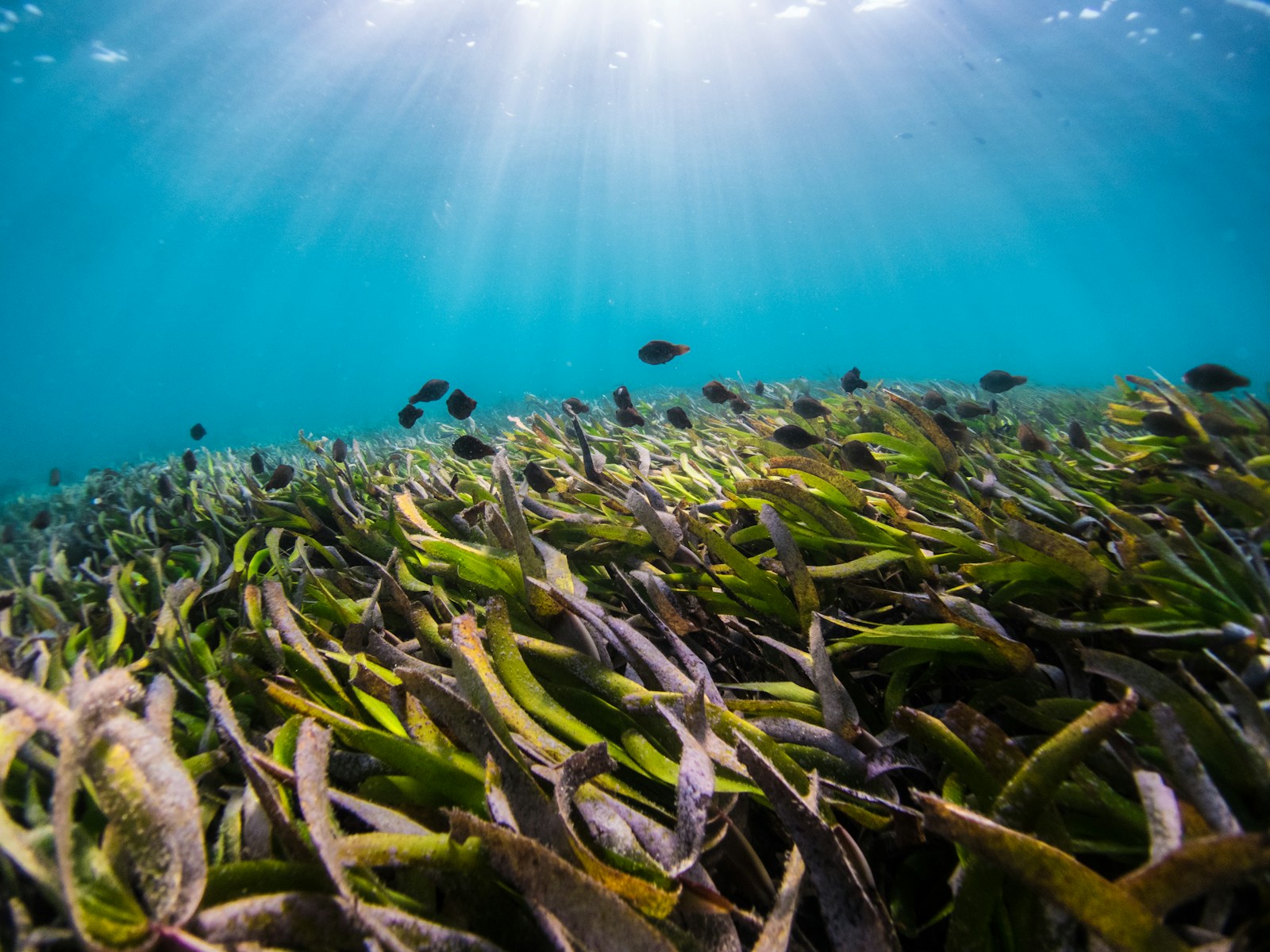
Beneath the waves around the British Isles, vast meadows of eelgrass provide a home for hundreds of small marine creatures, such as shrimps, snails, isopods and worms that form the foundation of coastal food webs. But new research warns that rising nutrient pollution is emptying these habitats of the wildlife that depends on them.
The study, published by scientists at Swansea University and the charity Project Seagrass, is one of the first to examine how nutrient enrichment affects the animals living on seagrass leaves at a large scale. Researchers surveyed 16 eelgrass sites across the British Isles, from Scottish sea lochs and Welsh estuaries to the Fleet Lagoon in Dorset and the waters around Orkney, identifying 50 species of small invertebrates, known as epifauna, in the process.
Seagrass meadows, including eelgrass, are already among Britain’s most threatened habitats, having declined dramatically over the past century.
The research found that higher levels of nitrogen in seagrass leaves were generally associated with sharp falls in the abundance and diversity of these creatures. In the most polluted conditions, a single unit increase in nitrogen corresponded to roughly a 90% decrease in animal abundance per unit of leaf area.
Phosphorus, the other major nutrient pollutant, was found to be particularly damaging in enclosed lagoon environments, where water moves slowly and nutrients build up.
Nitrogen and phosphorus enter coastal waters primarily through agricultural runoff and sewage discharge. Once in the water, they fuel the growth of algae that coat seagrass leaves, blocking sunlight, reducing oxygen and ultimately degrading the habitat.
On a more positive note, however, in estuaries and around islands, moderate nitrogen levels were actually linked to slightly higher biodiversity, suggesting that a small amount of enrichment can boost food availability without overwhelming the ecosystem. It is only when nutrient levels climb higher that the damage becomes clear.
The authors noted: ‘Eutrophication, the enrichment of water by nutrients, remains one of the most pressing environmental challenges in coastal waters, particularly regarding biodiversity loss.’
Perhaps the most surprising finding was what did not matter: the physical characteristics of the seagrass plants themselves. Leaf length, width and biomass had almost no bearing on how many species were present. What counted far more was where the meadow was located and how much nitrogen it was absorbing.
The researchers stress that this means conservation strategies need to become far more tailored. A single national water quality target, applied uniformly across all coastlines, is unlikely to protect the full range of seagrass habitats. Lagoons, estuaries, coastal beds, and island meadows each respond differently to nutrient stress and need to be managed accordingly.
The authors concluded: ‘Our findings demonstrate that eutrophication alters biodiversity in complex ways. Effective management will require site-specific nutrient reduction and monitoring strategies that reflect local conditions rather than uniform regional targets.’
The full research can be read here.
Photo: Benjamin L. Jones