













As early plans are plugged in for 2027’s meeting of energy innovators, we take a stroll around one of the continent’s most important green tech hubs.
Arnhem’s Cleantech Park does exactly what it says on the tin. Spanning 90 acres on the edge of the city limits, flanked by the Nederrijn (the Dutch Rhine) and its tributary river, the IJssel, this innovation hub is home to around 130 companies pushing boundaries across a multitude of industries. Battery storage. Hydrogen vehicles. Sustainable wood. The list could go on. And on.
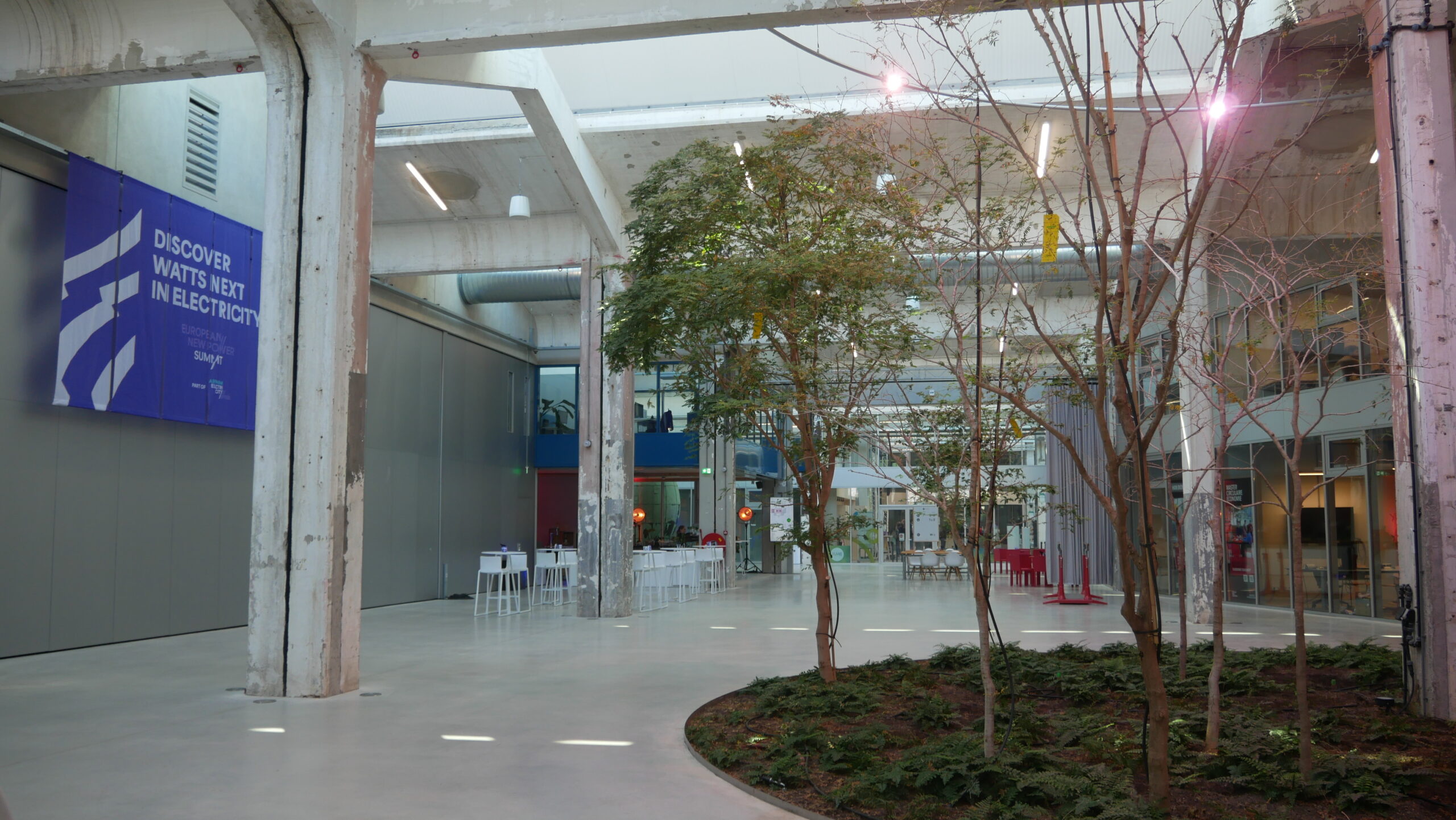
It’s a densely packed concentration of warehouses, laboratories, windmills, and solar arrays, taking over and expanding on factory buildings dating back to the 1940s. Some of these functionalist structures were once home to straw cellulose and cellulose fibre manufacturers, fueling a thriving clothing industry. One was a former recycling plant. Today all have been spectacularly repurposed to drive the engine rooms of a very different age.
The companies based here are committed to breaking new ground, and even their own operations are contributing to the development of cleaner and more efficient industrial processes. Wind and residual heat are just two of the renewable power sources utilised, alongside biomass, green and grey hydrogen. An e-boiler will soon come online, molten salt is turned into an energy storage system.
Inside Connectr, a 17,000 square metre workspace hub, we are given the motto. ‘2030 is tomorrow’ means there is no time to waste when it comes to developing solutions to the some of the biggest energy challenges of our time. Which is why it makes sense that the city of Arnhem — considered the epicentre of the Dutch grid — has nurtured this community of science and engineering experts in such close proximity to each other. A place where collaboration becomes second nature, and the results speak for themselves.
100% fossil fuel free biogas provider Powercrumbs has achieved close to zero-nitrogen emissions in its processes by utilising wastewater from a nearby treatment plant. Elestor is following in the footsteps — or vapour trails — of research started by NASA, developing energy storage systems for off-world and orbital scenarios and situations. Not forgetting the newly launched National Center for Grid Congestion, where 37 organisations are working to expedite the time it takes to bring new renewable infrastructure online.
KEMA Labs is also here, one of the world’s foremost high voltage grid equipment testing specialists. The goal is to ensure kit is safe before being deployed across the world, so cables don’t burst into flames beneath city streets, and no substations or giant transformers blow up. Meanwhile, at HAN University of Applied Sciences, many students and researchers are focused on improving and facilitating energy transition. Others are working on modular cars or improving seed yield by 50% through climate control techniques.
So it’s little wonder Arnhem is also the location of the newly christened European Electricity Week (formerly Arnhem Electricity Week) and its flagship event, the European New Power Summit, which runs four stages for dozens of speakers from the continent’s energy sector. Themes for 2026 included Reliability & Affordability, Digitisation & New Technologies, International Regulation & Cooperation, and People, Social Innovation & Design. And a chance to visit the Cleantech Park.
Considering the difficulties in reconciling shrinking national budgets, pressure from net zero sceptics, and the urgent need to achieve greater levels of energy independence, the conversations that take place are vital in both industrial and political terms. They go behind simply powering up the technologies we rely on everyday, and have tangible impacts on public health and the very question of how society can survive, thrive and function in the coming decades when we are facing a climate crisis brought about by dirty energy, alongside capacity and renewable infrastructure issues that mean greater efficiency is arguably the most pressing issue for the sector.
The programme for European Electricity Week 2027 has yet to be revealed, but again it will offer an opportunity for the industry to gather, discuss, and lay the groundwork for greater collaboration and innovation. And at a time when there has never been a greater demand for effective, scalable solutions to the challenge of electrifying the planet’s energy networks. 7,000 visitors attending more than 60 events at the last edition, the likelihood numbers increase next time, as more professionals look to plug-in and ‘discover watts next’, seems high.
European Electricity Week will run from 24th – 27th May 2027 across various locations in Arnhem. Full details are available here.
More on energy:
The truth about how seriously China is now taking climate change
7% energy saving if frozen food is stored at higher temperature
Burnham’s publicly-owned grid firm emphasises private sector utilities failure