


















India faces a significant threat from contaminated soil and groundwater, the main problem being, no-one really knows where it is.
According to government records, the country has just 103 officially recognised contaminated sites as of March 2025. To put that in perspective, Switzerland, a country roughly 80 times smaller than India, has identified around 4,000 contaminated sites. The United Kingdom has more than 11,000.
A new study, led by the University of Bristol, argues that India’s fragmented environmental policies are hiding the true scale of the problem, pointing out that they have identified around 4,000 contaminated sites.
Co-author Dr Kavitha Sambasivam, from the Vellore Institute of Technology in India, explains: ‘Many sites are located in densely populated areas, and that contamination often remains hidden while persisting for decades. Contaminated site management often falls across various regulatory areas, including soil protection, groundwater management, hazardous waste regulation and public health.’
The scale of the problem becomes evident when one considers that India is home to roughly 44,000 companies that produce over 7 million metric tonnes of hazardous waste each year. Illegal dumping, landfill leaks and industrial accidents have poisoned land in many areas.
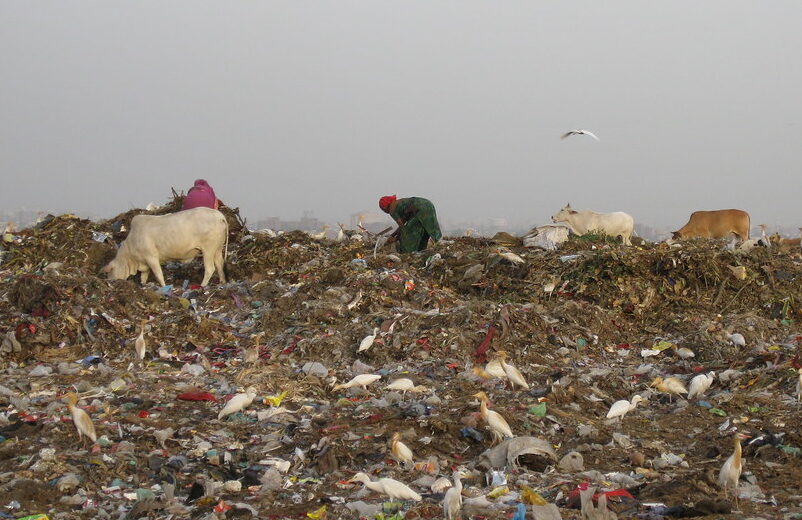
The infamous Ghazipur landfill in Delhi (pictured), releases toxic leachates containing lead, arsenic and cadmium into nearby water sources, along with thousands of tonnes of methane annually.
Lead author environmental scientist Dr Jagannath Biswakarma from the University of Bristol, said: ‘Contaminated sites are often invisible environmental problems. Pollutants may accumulate slowly in soil and groundwater, but the effects can last for generations if not properly managed.’
India’s environmental laws are spread across multiple ministries and agencies with overlapping or conflicting responsibilities. This fragmentation makes it difficult to track contamination, share data or enforce cleanups effectively. The official list of priority pollutants remains limited, ignoring dangerous substances like certain brominated compounds and microplastics.
To fix this, the study proposes an integrated framework called CS-MAR, which stands for Contaminated Site Monitoring, Assessment, and Remediation. The model draws on successful examples from the United States, the United Kingdom, Switzerland, and Australia. It calls for a centralised database of all industrial pollution, public access to real-time monitoring data, and community involvement in decision-making.
Study co-author Professor Asif Qureshi, from the Indian Institute of Technology Hyderabad (IITH) in Telangana, India, said: ‘Environmental governance systems differ widely between countries. Our study outlines possible pathways for integration, but real progress will depend on institutional coordination, political commitment, and investment in environmental monitoring.’
Study co-author Professor Ravi Naidu added: ‘The proposed coordinated framework could also be used by other countries in the Global South facing similar challenges relating to industrial contamination and environmental governance.’
The researchers also recommend training programs for local professionals, public-private partnerships to fund cleanups, and innovative financing tools such as green bonds. They stress that public awareness campaigns and citizen-led monitoring could transform how contaminated sites are managed.
The full research can be read here
Photo: The Advocacy Project