

















Researchers have created a new type of ‘living plastic’ capable of destroying itself when triggered, offering a potential solution to one of the world’s biggest waste problems: single-use plastics that linger in the environment for decades.
The innovative material, developed by a team of scientists and reported in American Chemical Society journal, combines plastic with dormant bacteria engineered to digest it from the inside out. In laboratory tests, the material completely decomposed in less than a week — without leaving behind harmful microplastics.
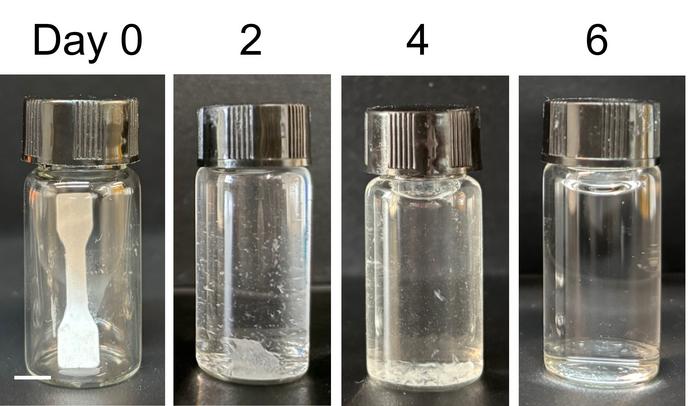
A living plastic with a pair of cooperative, plastic-busting enzymes degraded the material completely within six days.
Traditional plastics are designed for durability, but that strength becomes a problem when products such as packaging are discarded after only brief use. The research team wanted to rethink that lifecycle by building decomposition directly into the material itself.
Lead researcher Zhuojun Dai said: ‘the realisation that traditional plastics persist for centuries, while many applications, like packaging, are short-lived, led us to ask: Could we build degradation directly into the material’s life cycle?’
To make the concept work, the team turned to bacteria. Certain microbes naturally produce enzymes that can break long polymer chains into smaller molecules. Rather than relying on a single enzyme, however, the scientists engineered the bacterium Bacillus subtilis to generate two separate enzymes that work in tandem.
One enzyme cuts the plastic into smaller fragments at random points, while the second methodically breaks those fragments down into their smallest molecular building blocks. This two-step process proved far more efficient than earlier single-enzyme approaches.
The bacteria were added in spore form – a dormant state that keeps them inactive until needed – and embedded into polycaprolactone, a biodegradable polymer commonly used in 3D printing and medical sutures.
Dai explained: ‘By embedding these microbes, plastics could effectively ‘come alive’ and self-destruct on command, turning durability from a problem into a programmable feature.’
Importantly, the resulting material retained the same strength and flexibility as standard plastic films, meaning it could still perform like conventional plastic during use.
But once exposed to a nutrient solution heated to 50°C (122°F), the spores ‘woke up’ and activated the breakdown process. Within six days, the plastic had been fully reduced to its original chemical components.
Researchers say one of the most significant breakthroughs was that the process avoided generating microplastics, a common problem in plastic degradation.
To demonstrate its practical potential, the team also produced a wearable electronic sensor using the material. The prototype functioned normally before completely degrading within two weeks.
Looking ahead, the scientists hope to design activation systems that work in water, where much of the world’s plastic pollution accumulates. They also believe the same microbial strategy could be adapted for other plastics, including those widely used in disposable packaging.
The full research can be accessed here
Photo: Adapted from ACS Applied Polymer Materials 2026, DOI: 10.1021/acsapm.5c04611