














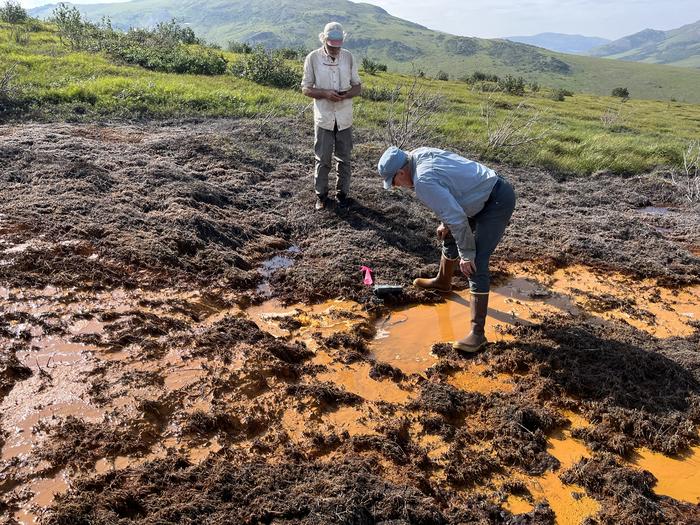
Over recent years, rivers that once ran clear through the Arctic wilderness have been turning a Trumpian shade of orange and scientists now say they have definitive evidence to explain why.
The new study confirms what earlier research had suggested, that thawing permafrost is contaminating remote rivers, discolouring them with toxic iron particles that threaten entire aquatic ecosystems.
The research, which was carried out in Alaska’s Brooks Range, identifies two distinct mechanisms at work which, it is hoped, could help predict where the damage will strike next.
Roman Dial, math and biology professor emeritus at Alaska Pacific University and first author of the study, said: ‘At middle, more heavily forested elevations, there isn’t much going on. But at the higher and lower elevations we could see distinctly different phenomena.’
At higher elevations, the culprit is a process known as acid rock drainage. Underground deposits of pyrite (aka fool’s gold) have been kept inert by the frozen ground surrounding them. As warming temperatures thaw that permafrost, water and air reach the pyrite, triggering a chemical reaction that leaches acidic, iron-rich runoff into rivers.
Tim Lyons, UC Riverside biogeochemist and paper co-corresponding author said: ‘When pyrite meets water, it comes apart. It breaks down into iron and sulphur, creating sulphuric acid as well as sulphate and other toxic metals. When the iron-rich water mixes with more oxygen, the iron turns into rust-like particles that color the water and stain the bottom sediments orange.’
In lower-lying wetland areas, a separate biological process is responsible. As permafrost melts, oxygen-poor soils expand, encouraging bacteria to effectively ‘breathe’ iron rather than oxygen. This releases iron into the surrounding waterways through a pathway entirely different from the previous mechanism.
Dial explained: ‘When we breathe, oxygen goes in and gets converted to the carbon dioxide that we exhale. Similarly, microbes are consuming iron in the lowland soils and converting it into a water-soluble form that seeps into streams and results in rusting as it meets oxygenated surface water.’
The potential consequences of this rusting are considerable, as these fine iron particles can stay suspended in water for more than 100km, clouding rivers, smothering algae, disrupting insect populations and clogging fish gills.
In Alaska and neighboring Canada, the team suspects these changes are affecting salmon, which rely on clean gravel beds for spawning and on algae-based food webs during early life stages.
The team believe their findings suggest that the problem will not be confined to Canada expand globally.
Lyons said: ‘It’s already happening in Russia, and will keep happening anywhere you have the right geology and warming temperatures. It started as a canary in a coal mine in the Brooks Range, but now those canaries are chirping all over.’
On a more positive note, the study also reveals a delayed effect that could help predict future contamination. Each summer, the top portion of soil thaws to its deepest point before refreezing in winter. Iron released during one thaw can become trapped, then flushed into rivers the following year.
By analysing long-term ground temperature data alongside stream chemistry, the team found that this lag can be used to anticipate increases in metal levels.
The full research can be read here.
Photo: Tim Lyons/UCR