













Primary school children equipped with thermal cameras are helping redesign their schools to cope with hotter summers, thanks to a University of Surrey programme that gives pupils the tools to spot dangerous heat hotspots and develop their own cooling solutions.
With heatwaves becoming more frequent across the UK, reaching highs of 36°C in parts of London, the ‘Heat-Cool’ programme designed by Professor Prashant Kumar has shown that children as young as nine can use thermal imaging technology to investigate how heat builds up around their schools, using evidence they gathered themselves to design greener, cooler spaces.
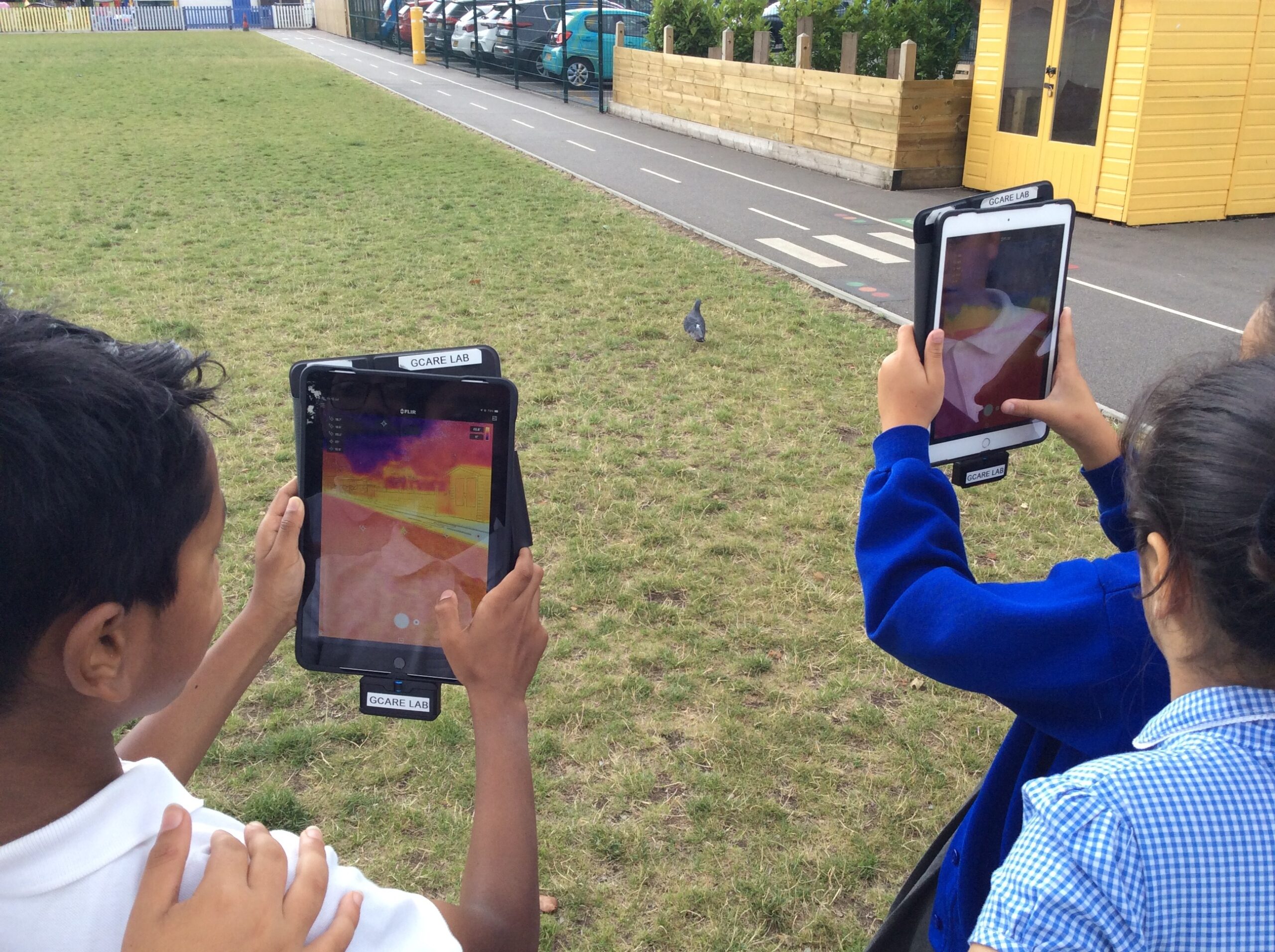
In a study published in Environmental Research Communications, researchers led by Surrey’s Global Centre for Clean Air Research (GCARE) rolled the programme out to more than 500 children at seven schools across the South East. During two-hour workshops, pupils measured differences in surface temperatures across school grounds using handheld thermal cameras. They then worked out which nature-based solutions would work best for specific areas, such as green roofs, ponds, rain gardens and shaded outdoor spaces to reduce overheating.
After taking part, more than eight in ten pupils either maintained or improved their understanding of climate change, while students overwhelmingly rated the experience as enjoyable and engaging.
Professor Prashant Kumar, Founding Director of GCARE and corresponding author of the study, said: ‘As the UK experiences hotter summers, we need to think differently about how we prepare schools for a changing climate. Children are among those most affected by extreme heat, yet they’re rarely involved in designing solutions.
‘Our Heat-Cool programme turns pupils into climate detectives. Give them thermal cameras and the right knowledge, and they can quickly see which parts of their school are heating up and which natural features help keep spaces cool. They then use that evidence to develop practical ideas for making their schools more resilient.’
The research team analysed more than 1,700 thermal images captured by pupils, covering over 4,300 objects around school grounds. The findings consistently showed that natural, water-based and engineered green infrastructure was typically between one and three degrees cooler than surrounding areas without it, although students favoured infrastructure-integrated solutions such as green roofs.
Dr Jeetendra Sahani, Research Fellow at GCARE, said: ‘It was a proud moment watching children discover that some of the coolest places around their school were also the greenest. They weren’t just learning about climate change in a classroom – they were gathering real evidence, interpreting it and using it to design practical solutions for their own environment. I think this is such a special way to help young people understand both the challenges we face and the role they can play in tackling them.’
Combining classroom learning with citizen science and technology, the programme encourages pupils to investigate their own school environment and develop effective solutions to help make buildings and playgrounds more bearable in the warming climate.
Researchers believe the approach could be adopted more widely to help schools prepare for rising temperatures while improving climate literacy and encouraging young people to play an active role in shaping more resilient communities.
The full research can be read here.
Photo: University of Surrey