















Building solar parks on previously drained, rewetted peatlands can support a wider range of bird species than continuing intensive grassland farming, new research suggests.
The study, published in Ecological Solutions and Evidence, is the first to examine how bird communities respond to this emerging land use, which combines renewable energy production with peatland restoration.
Researchers from the University of Greifswald in northern Germany used audio recorders and machine learning software to monitor bird activity throughout a full migration and breeding season at a single rewetted peatland solar park. They compared the bird community there with two adjacent sites still used as intensively managed, drained grassland – representing the former land use.
While the total number of bird species was similar between the two land use types, the rewetted peatland solar park hosted significantly more common and dominant species. More importantly, the types of birds present differed markedly between the sites.
The solar park attracted a unique mix of species typically associated with very different habitats. Wetland birds, such as the white wagtail and reed bunting, were found there, alongside species more typical of woodlands, including the Eurasian tree sparrow and tree pipit. In contrast, the drained grasslands were dominated by open-landscape birds like the Eurasian green woodpecker and European goldfinch.
Hanna Rae Martens, a peatland ecologist at the University of Greifswald and lead author of the study, said: ‘The presence of wetland species like reed bunting and the endangered meadow pipit shows that the solar park is truly re-wetted and has peatland species returning.
‘But we also recorded species like Eurasian tree sparrow and tree pipit which are not typically found in peatlands. They all appear to use the structure of the solar panels. When I’m out on site, I see a lot of meadow pipits sitting on the panels, flying off to catch insects and then flying back to their perch.’
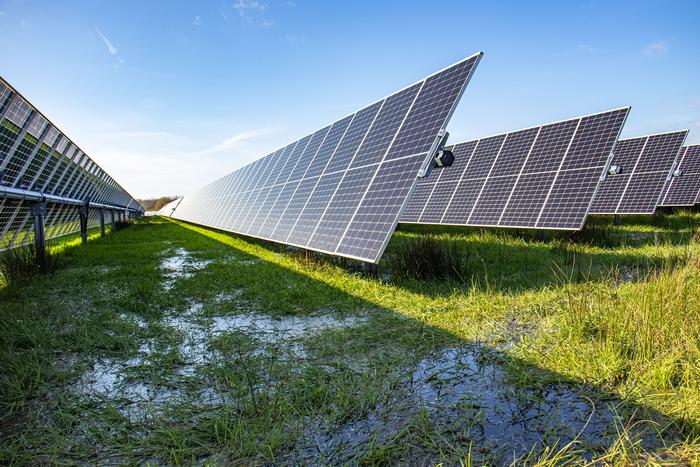
The solar park was managed with biodiversity in mind: mown only once per year in late summer with biomass removed, and built without levelling the land. The panels stand 1.45 metres off the ground, with rows spaced four metres apart, while a fence that doesn’t reach the ground allows small animals to enter.
By contrast, the drained grassland sites were mown four times annually, seeded, fertilised, and criss-crossed with drainage ditches up to one metre deep.
Natural peatlands are waterlogged ecosystems such as bogs or fens,where dead plant material accumulates faster than it decomposes, forming carbon-rich peat. However, peatlands are often drained for agriculture, forestry or peat extraction, which exposes causes rapid decomposition, releasing large amounts of carbon dioxide
Rewetting involves blocking drainage ditches, removing drainage infrastructure, or raising water tables to restore near-natural wet conditions; this stops carbon loss, reduces greenhouse gas emissions, and can allow peat-forming vegetation to recover.
The findings suggest that solar parks on strongly degraded peatlands – rather than on nature-sensitive areas or moderately drained sites with high restoration potential – could help support bird diversity in agricultural landscapes. With 95% of Germany’s peatlands degraded, mainly for farming, the approach may offer a way to cut greenhouse gas emissions while also benefiting wildlife.
Martens added: ‘Where the alternative is a drained, intensively managed peatland, our research demonstrates that solar panels on rewetted peatland might benefit bird diversity. But we’re not suggesting that we should be turning all peatlands in Germany, the UK, or any other country into solar parks. Healthy peatlands or those with high restoration potential should be avoided. Solar parks are just one possible tool to support peatland rewetting.
‘To date, there are approximately five rewetted peatland solar park sites in existence. More research is needed to draw robust conclusions as to whether these findings occur in other sites as well, and which factors are contributing to the species composition.’
The full research can be read here
Photo: Wattmanufactur