














Ahead of the UN Ocean Conference, the head of a women-led organisation making coastal communities on the subcontinent more resilient shares thoughts and recommendations to tackle the mounting waste crisis, locally and internationally.
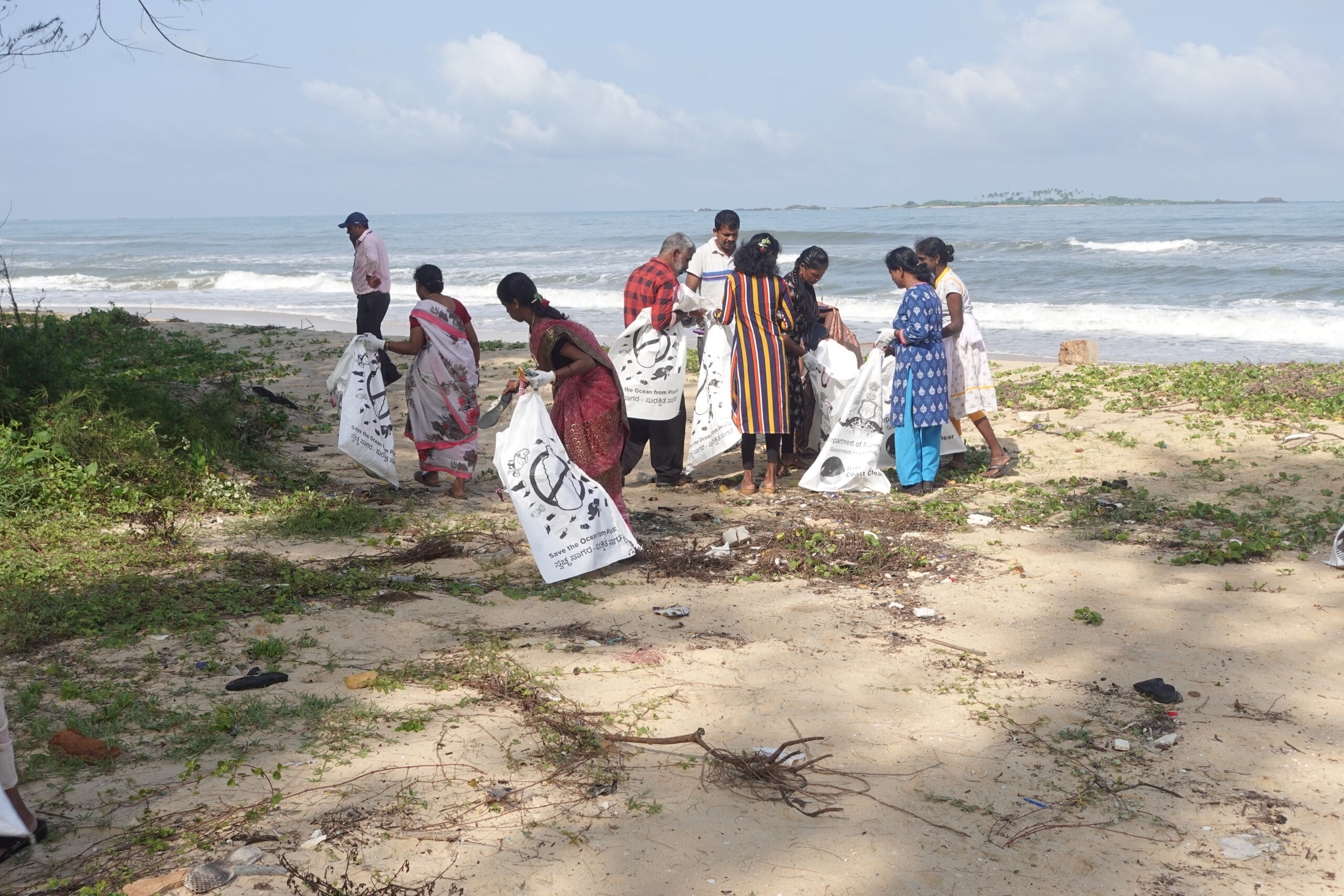
Baeru is a women-led climate organisation working towards ‘leak-free’ end-to-end waste management and circular economics. Based in the Indian state of Karnataka, the team focus on three actions – establishing and building on partnerships with local government bodies, developing infrastructure and generating new income streams.
At the centre of all this is a devastating truth. Plastic pollution isn’t just decimating beaches and marine ecosystems – it’s destroying jobs. A message Baeru Founder and CEO Divya Hegde tells us is key to engaging communities whose most pressing priority is bringing in enough money to feed their family.
‘Our region, like most of the ‘Global South’, faces immense pressure [from plastic pollution]. Fisheries are getting louder about this as more plastic is being found in nets, and less fish,’ says Hegde. ‘When you throw away rubbish into water bodies, you’re not just throwing away trash, you’re throwing away livelihoods.’
Baeru’s fundamental aim is the clean India’s coastline, but the organisation didn’t start out picking up pieces of plastic on formerly-pristine beaches. Instead, things began with conversations, first targeting demographics like high school and college students, before realising young and educated people were already on-side. Meanwhile, more difficult to reach groups were unlikely to respond to the same messaging.
‘We wanted to focus on language. So every stakeholder needs to have skin in the game. It’s not just about clean beaches. The groups that are most impacted need support in terms of livelihoods, so they can build sustainable incomes,’ Hegde explains. ‘I can’t go to my community and say the Earth is heating by 1.5 or 2C when we already have 38, 39, 40C temperatures. They’d look at me like I was crazy. So we need to focus on what is hurting the people we talk to – like fisheries.’
If this approach seems pragmatic, the process involved is unarguably practical. Baeru upskills women in waste management and circularity principles, then secures them work collecting, segregating, washing, drying and organising plastic and other items found on coastlines. These are then turned into functional products where possible. Those being trained and employed are primarily from difficult economic backgrounds and differently abled persons.
‘This system can work, but all stakeholders need to be involved in the crisis – that means you, me, governments, companies. You can’t expect one group to continue generating waste and another to sort it out,’ Hegde quips, guiding our conversation towards the elephant in the room: local, regional and international inequalities. ‘So now we are bringing in technology to track everything. We talk about lack of data, but it’s not just that. It’s the deniability it creates.
‘[In Karnataka], we already have policies that penalise people for non-segregation of waste,’ she continues. ‘But how is this enforced without traceability? This is more important than the development of infrastructure, because often that’s already there – a lot of the time you don’t need new capital for facilities, you need to fully leverage what’s already there.’
We ask Hegde for any policy recommendations. She begins by suggesting local communities should be actively involved in developing regulations and initiatives. Young people and women should be seen as ‘force multipliers’. We’re also told there needs to be a shift in focus from who pollutes least to who reuses more. It’s striking how these ideas could easily be applied to Ipswich or Inverness, rather than India.
‘Regional and international platforms need to recognise frontline communities – say coastal fisheries – and understand these are not just vulnerable people, they are innovators. The moment you consider them as co-creators, and not just recipients of what you decide, you are already getting greater buy-in,’ says Hegde. ‘We also need to stop the flow of waste from ‘Global North’ to ‘Global South’, this needs to be really urgently addressed.’
On Monday 9th June, the UN Ocean Conference opens in Nice, France, with the aim of accelerating and increasing efforts to conserve and use the seas more sustainably. Before that, Sunday 8th June is World Ocean Day. Both are nice ideas, but as successive summits and the near-endless line of observation dates show, paying lip service to environmental crises is getting us nowhere. As our call with Hegde comes to an end, we ask about her hopes for next week’s gathering, and what should be prioritised in the name of protecting marine ecosystems and the communities that rely on them.
‘I think they need to expand the narrative from mitigation to regeneration. You could cry day and night about replacing plastics but what are the alternatives? You can ask the public to stop using them, but what you have to do is talk about consumption,’ she replies. ‘For longevity and storage what else are we being offered? Plastic itself is not the evil.
‘There are lots of organisations working on research, fantastic startups, which can introduce alternatives. They need better funding to fail fast and then iterate and move forward,’ Hegde continues. ‘So within the social impact sector, if more and more organisations come in and say – ‘you know what, we have the appetite for this’ – then you will see greater wins. But what happens is the line between VC funding for other private sector businesses and social impact get blurred. We have to stop expecting hockey stick growth from social impact. It doesn’t work that way.’
You can find more information about Baeru here.
Baeru is supported by TRANSFORM, an impact accelerator led by Unilever, the UK’s Foreign, Commonwealth, and Development Office, and EY, which supports visionary enterprises across Africa and Asia.
All images: Baeru
More Features & Opinion:
Chelsea show to city streets, tech regenerates nature in urban areas
Could UK innovators help ‘turn back the clock’ on Earth Overshoot Day?
Sustainable palm oil can plant seeds to balance people and place