















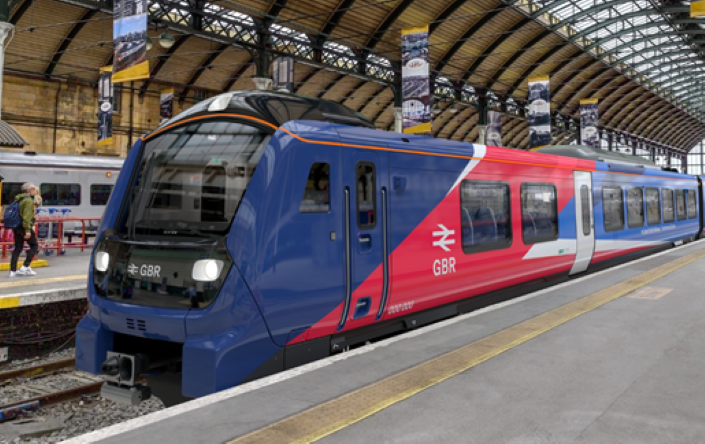
TransPennine Express (TPE) is set to introduce Britain’s first mainline battery-electric trains as part of a £1 billion investment designed to transform rail travel across the North of England.
The operator has signed contracts with rail manufacturer Alstom for 29 new five-car battery-electric trains, along with maintenance services, depot facilities and new charging infrastructure.
The new fleet, known as Adessia Stream, will be funded by rail investor Rock Rail and manufactured at Alstom’s Litchurch Lane Works in Derby, described as Britain’s only end-to-end train manufacturing facility.
The trains will form part of the wider Transpennine Route Upgrade programme and are expected to operate on routes connecting Liverpool, Manchester, York, Hull, Scarborough and Saltburn.
The new fleet will replace part of TPE’s existing Class 185 trains while providing increased capacity. Passengers will also benefit from more luggage space, Wi-Fi, passenger information screens and power and USB-C charging at every seat.
Dedicated cycle storage and quieter, more comfortable interiors are also planned.
Accessibility is a major focus of the new trains. Level boarding will be provided at every doorway, allowing passengers to board and leave trains independently at the vast majority of stations across the network.
Each train will also have three dedicated wheelchair spaces, two accessible toilets, family-friendly areas and spaces for buggies.
The investment is expected to create and support jobs beyond the railway. More than 350 highly skilled manufacturing positions are expected to be supported in Derby, while Alstom estimates that more than 5,500 roles will be supported across its UK supply chain.
The fleet will also create more than 100 maintenance roles under an initial eight-year contract, with the possibility of extending the agreement for a further eight years.
Chris Jackson, Managing Director at TransPennine Express said:’ This is a transformational £1 billion investment in the future of rail travel across the North, delivering new trains for our customers as well as new infrastructure, new jobs and long-term economic benefits.
‘Britain has a proud railway heritage, and this project puts the UK at the forefront of the next generation of cleaner rail technology.’
The battery trains will be particularly important on sections of the network that do not yet have overhead electrification. New charging facilities will be installed at Hull, Scarborough and Saltburn, allowing the trains to recharge while in service and run without direct emissions on unelectrified sections.
Manufacturing is expected to begin in 2028, with the full fleet scheduled to be delivered by winter 2032. Passenger services are expected to begin no later than winter 2034.
James Richardson, Managing Director of the Transpennine Route Upgrade, said: ‘TRU is transforming train travel across the north, and today’s announcement is a major step for the programme as we work to deliver a railway that better connects our communities. The £1 billion investment reflects a genuine commitment to transforming rail travel across the region and beyond.
‘A stronger North depends on better connections, and TRU is bringing the north together and unlocking opportunities.’
Photo: Alstom