


















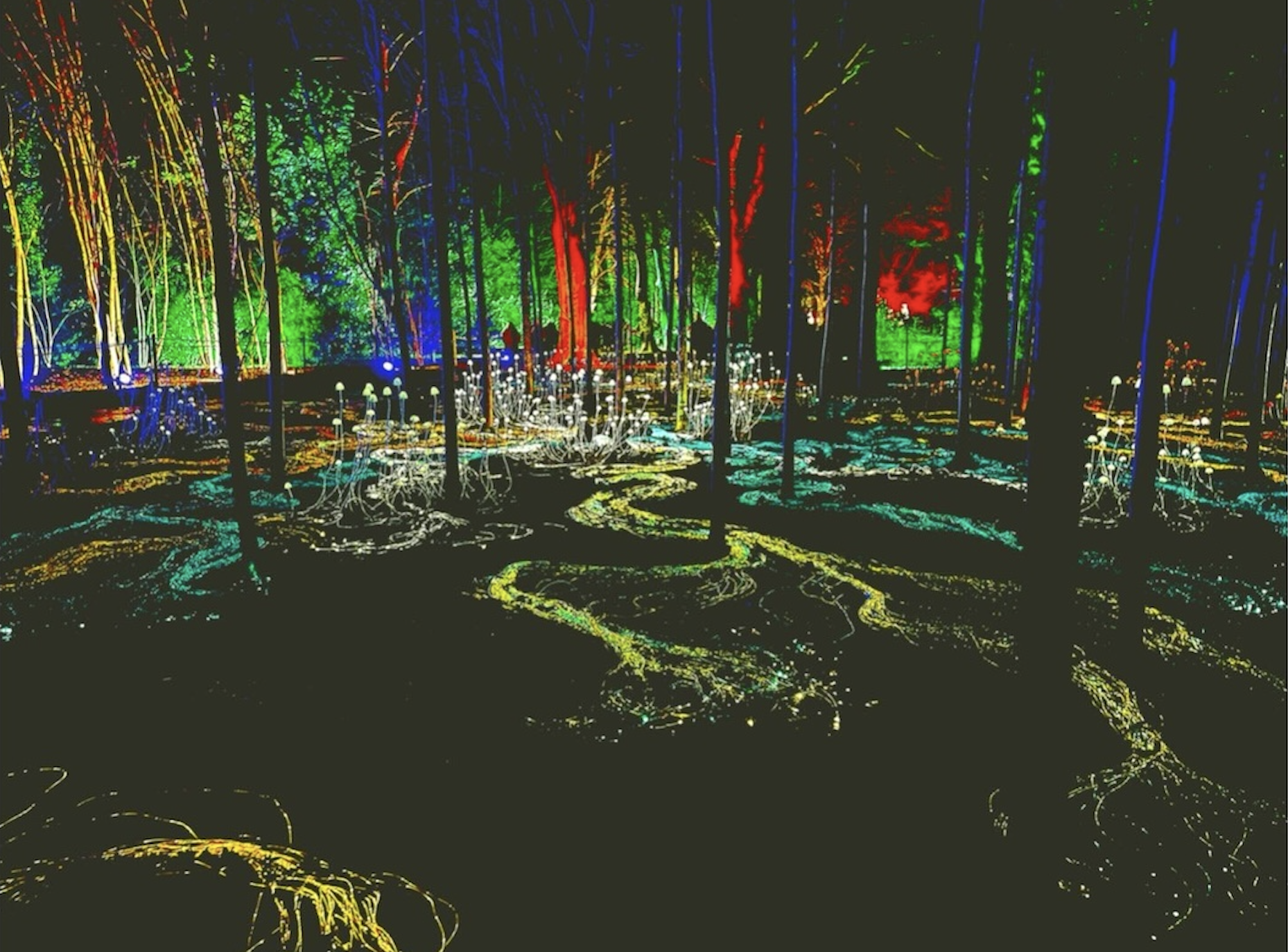
The vast underground fungal system is responsible for distributing nutrients and water, and storing carbon. But the habitats it thrives in are vanishing.
It’s hard to overstate the importance of our planet’s mycelium network. Made up of several forms of fungi that live amongst the roots of plants, trees, flowers and grasses, if laid out end-to-end just one of these species— AM fungi — would stretch 110 quadrillion kilometres, according to a recent study by the Society for the Protection of Underground Networks (SPUN).
Putting that into context, it would be able to span across around one-tenth of the entire Milky Way, or 11,000 light years. A huge area, connecting 70% of all our planet’s plant species, unsurprisingly AM fungi system alone can hold 300 megatonnes of carbon, with the annual intake estimated at around 4 billion tonnes. That’s roughly the equivalent to all emissions from the US.
Unfortunately, current research is also showing that there could be a big problem with this network of natural resource subterranean superhighways. In the case of AM fungi, for example, 40% is held in wild grasslands. According to BBC Science Focus, these environmental regularly rank amongst the least protected on Earth, with agricultural expansion threatening their very existence in many global regions.
When the land is ploughed, the microscopic fungal threads are torn apart, meanwhile the use of chemical fertiliser means plants can still grow without the underground life support machine. In the natural order of things, nutrients delivered to flora from below ground are ‘swapped’ for vital sugars which keep the fungus healthy. Without this exchange the latter withers and dies.
‘I hope this builds into the conversation for their protection, because wild grasslands are going away quite quickly,’ added Justin Stewart, an evolutionary ecologist at SPUN. ‘These are areas that people are really ripping up, because it’s much easier to rip up a grass than it is to rip up a tree.’
Previously published in the journal Nature, SPUN’s research found that 90% of all the planet’s mycorrhizal fungal network biodiversity hotspots — of which AM fungi is just one — are located in unprotected ecosystems. This raises serious concerns about what happens if damage to the systems cannot be repaired or is unable to recover.
‘They cycle nutrients, store carbon, support plant health, and make soil. When we disrupt these critical ecosystem engineers, forest regeneration slows, crops fail and biodiversity above ground begins to unravel,’ said Dr Toby Kiers, SPUN’s Executive Director. ‘450m years ago, there were no plants on Earth and it was because of these mycorrhizal fungal networks that plants colonised the planet and began supporting human life,’ he continued. ‘If we have healthy fungal networks, then we will have greater agricultural productivity, bigger and beautiful flowers, and can protect plants against pathogens.’