


















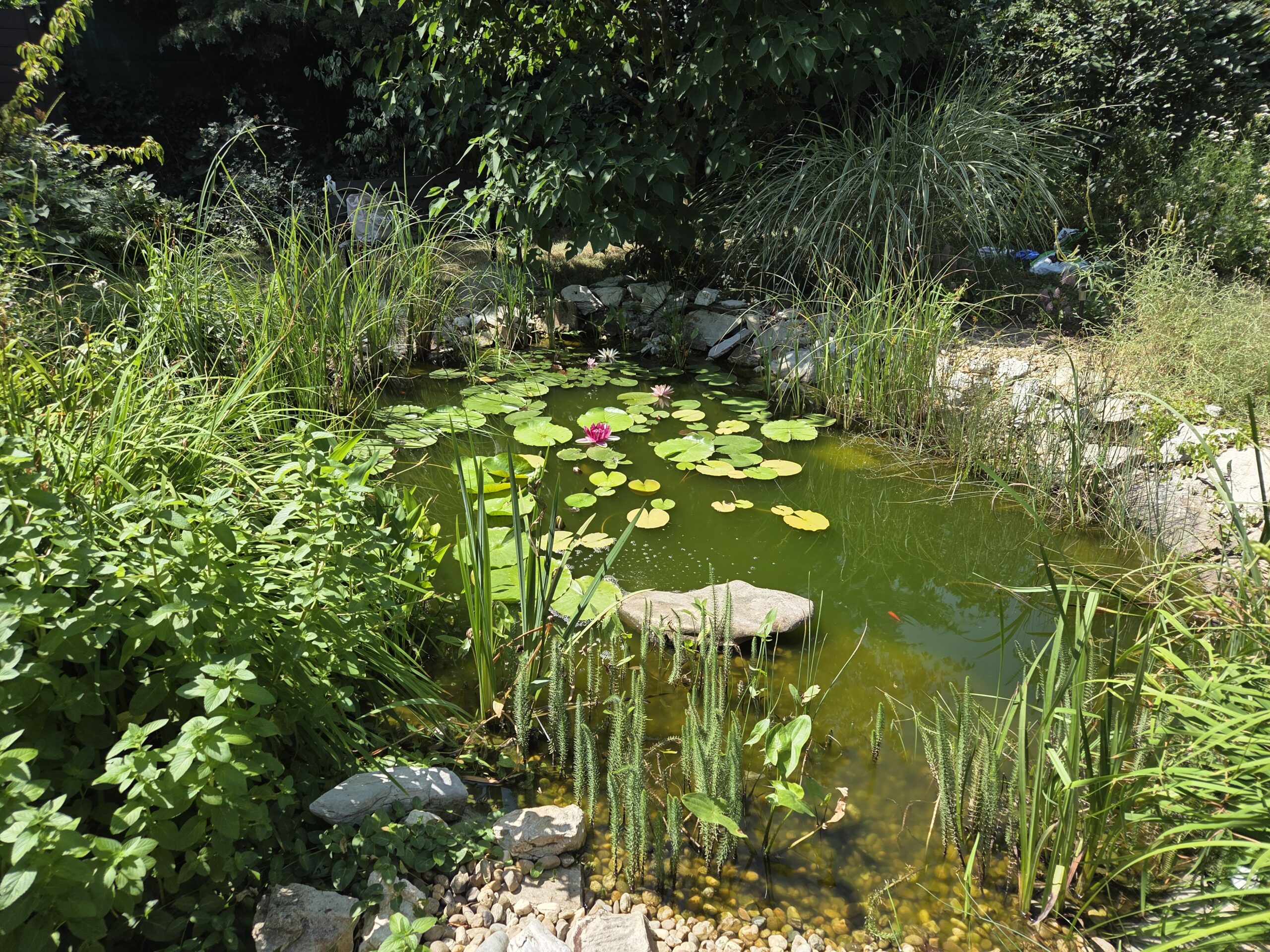
New research reveals that millions of overlooked garden ponds are biodiversity hotspots, but the presence of fish can dramatically tip the ecological scales.
As cities grow, artificial ponds are rapidly replacing natural waterways. Yet, while public park ponds have become a focus for scientists, the zooplankton communities living in the millions of private garden ponds have remained a mystery.
It was this that prompted a new study, which provides the first systematic look at these tiny ecosystems, revealing that garden ponds are vital players in urban biodiversity, although they play by different rules than their larger public counterparts.
An international team led by the HUN-REN Centre for Ecological Research in Budapest sampled 90 ponds – 38 in private gardens and 52 public urban ponds – and discovered a remarkable 95 species of zooplankton. These microscopic ‘ecological workhorses,’ including rotifers, cladocerans and copepods, are critical for controlling algal blooms and transferring energy up the food chain.
The results show a clear split, with urban ponds, typically larger and older, harbouring greater local and regional diversity, especially for crustaceans like Cladocera and Copepoda. In contrast, garden ponds were heavily dominated by rotifers, tiny animals that thrive in smaller, more isolated spaces.
Lead author Thu-Hương Huỳnh said: ‘Garden ponds are easy to dismiss as too small or too artificial to matter, but our results show they contribute meaningfully to urban biodiversity. Although they support fewer crustacean species than larger public ponds, they still share much of the regional zooplankton diversity.’
The team also noted the significant impact fish had upon the pond population.
Huỳnh said: ‘Fish are the real force reshaping these communities. This effect is strongest in the smaller garden ponds, where the zooplankton have so few places to hide that fish can restructure the entire community.’
Project leader Zsófia Horváth added: ‘A small garden pond may look like little more than a decorative water feature. Because many of these ponds are stocked with ornamental fish, most people would not expect them to harbour much microscopic life. Yet beneath the surface, we found an overlooked community of microscopic animals. Although ornamental fish strongly shape these communities, we still discovered two rotifer species never before recorded in Hungary, showing that even tiny urban ponds can reveal surprising biodiversity.’
In effect, a goldfish in a garden pond doesn’t just eat algae; it fundamentally reorganises the entire microscopic community. Conversely, the study found that urbanisation’s impact was less noticable in garden ponds, presumably because of their location within private green spaces, shielded from polluted runoff. Public urban ponds showed a much stronger decline in crustacean density as surrounding urban cover increased.
The full research can be read here.
Photo: My Pond Team (https://mypond.hu/summary/)