
















Artificial light at night is reshaping the flow of food between rivers and their banks, independent of other environmental pressures, according to a new study from Germany.
Researchers from RPTU Kaiserslautern-Landau conducted a six-week experiment using 16 artificial streams with adjacent ecosystems. They exposed some setups to artificial light at night using LED strips that mimicked typical street lighting, while keeping others in natural darkness.
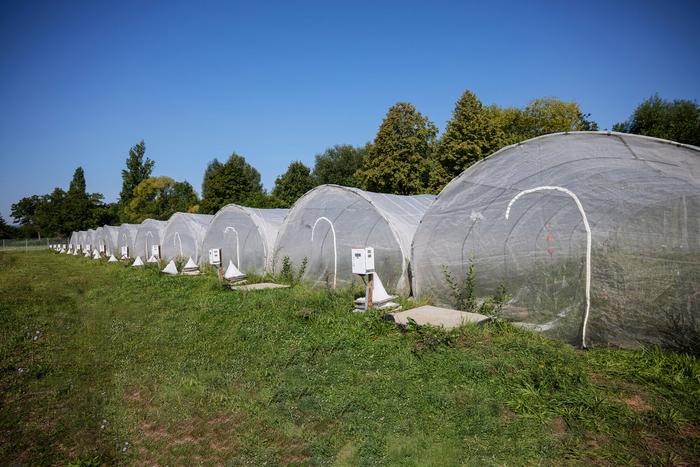
In a globally unique experimental facility, researchers in Landau are studying the interaction between aquatic and terrestrial ecosystems under human influence.
Using stable isotope analysis, the team tracked how light pollution altered the diet of the orb-web spider Tetragnatha extensa, a key predator that feeds on insects emerging from the water.
The study found that spiders living under artificial light at night ate a more varied diet than those in darkness. Their food choices were around 14% more diverse, probably because street-style lighting attracts a wider range of insects. This pattern held true whether the light was on its own or combined with other pressures like invasive crayfish.
The researchers note that artificial light at night is increasing globally by about 10% annually in sky brightness, driven largely by the expansion of street lighting in urban and suburban areas. Over half of the world’s population lives within three kilometres of a freshwater body, making riparian zones particularly vulnerable to light spillover.
Light pollution is known to alter insect behaviour in multiple ways. It can reduce the nocturnal drift of aquatic insect larvae, change the timing and pattern of adult emergence, and attract flying insects to illuminated areas where they become more vulnerable to web-building spiders. These effects can cascade through ecosystems, altering energy flow and feeding relationships among plants and animals living along riverbanks
Even when light pollution was combined with the presence of invasive signal crayfish, the spiders still showed a wider isotopic niche width than in the control treatment, suggesting that artificial light exerts a strong and consistent influence on predator diets regardless of other environmental pressures.
The findings are significant because light pollution has often been overlooked compared to other forms of environmental degradation. Unlike chemical pollution or habitat loss, artificial light at night is not regulated as an environmental pollutant in most jurisdictions, despite mounting evidence of its ecological impacts.
The researchers conclude that increasing urbanisation around freshwater ecosystems will intensify the effects of artificial light at night, altering resource flows between aquatic and terrestrial habitats with potential consequences for food web dynamics and biodiversity. They call for greater attention to light pollution as a driver of ecosystem change in its own right.
environmental scientist Ralf Schulz said: ‘The results make it clear that light pollution has been underestimated as an environmental factor, especially against the backdrop of increasing urbanization and infrastructure development along riverbanks.
‘It significantly alters the flow of energy and the transport of nutrients between water and land, even when other stressors, such as invasive species, are present.’
The full research can be read here
Photo: RPTU, Hans-Georg-Merkel