
















The model allows farmers to remain compliant with land application regulations and boost energy efficiency through heat recovery.
In the UK, agriculture contributes to around 12% of total national greenhouse gas emissions. Within the sector, some 10% of that output comes directly from manure.
Adding to the environmental footprint, large volumes of crop residue — including from straw — often go underutilised but could be used for climate and ecological mitigation. Now the University of Leeds has developed and evaluated a unique integrate approach to biochar production.
Unlike other designs, this allows for straw and manure to be processed separately via parallel pyrolysis lines, overcoming issues around land application regulations which have, until now, prevented some feedstock combinations.
Trials have been conducted at the institution’s own Research Far, and involved cradle-to-grave study to measure environmental performance. Economics were also assessed to determine value in real terms and prove that this new method would not only be sustainable in green terms, but also when judged financially.
The system was found to be capable of producing 300 tonnes of biochar each year, while sequestering 350 tonnes of carbon dioxide equivalent. This equates to a drop in manure management emissions of 75%, with an additional 30 tonnes of CO2e cut by using the surplus heat generated through pyrolysis to dry out the manure, which usually has high levels of moisture. Removing this to prepare the product for use is therefore often a highly intensive process.
‘Biochar is often discussed as a promising carbon removal solution, but real-world farm implementation has been limited,’ said lead author Yuzhou Tang. ‘Our study demonstrates that a regulation-compliant, farm-based system can simultaneously reduce emissions from manure, sequester stable carbon in soils, and improve energy use efficiency.’
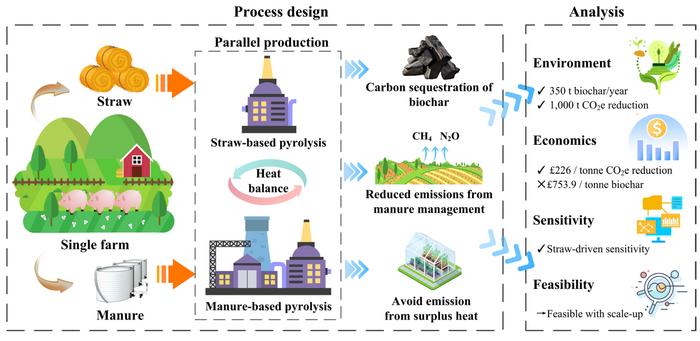
Environmental and economic assessment of biochar production systems from agricultural residues (C) Yuzhou Tang, Judith Ford & Tim T. Cockerill
However, despite impressive environmental results, the economics present significant, in the short term at least. Carbon abatement cost was put at £226 per tonne of CO2e, most of which is spent on initial capital investment, labour and electricity costs.
Biochar per tonne is priced at £754. Nevertheless, it is believed that through further optimisation, introducing modular system design to overcome the need to ‘replace-all’ in the event of malfunction or breakages, and better integration in farm management operations, the cost could come down.
‘Our findings provide a realistic framework for scaling biochar within the agricultural sector,’ Tang added. ‘With continued innovation and supportive policy, farm-based biochar systems could become a meaningful contributor to net zero targets.’
Image: Ries Bosch / Unsplash
More on Energy & Net Zero:
Iran war is just the latest example of unstable fossil fuel future
Nottinghamshire councils share £18m energy efficiency funding as bills fall