

















The facility is one of the country’s most advanced climate change resources.
Jointly operated and owned by The James Hutton Institute and the University of Edinburgh, the Scottish Observatory for Atmospheric Research (SOAR) went live last week. It is the latest addition to the UK-wide Deriving Emissions linked to Climate Change networks of observatories.
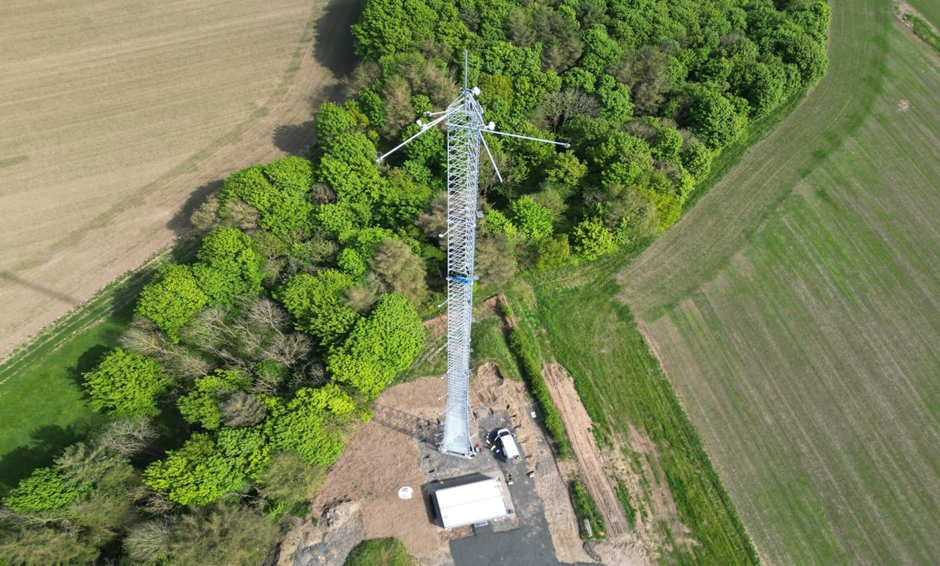
The 100 metre tall tower can measure more than 60 individual greenhouse gases — including carbon dioxide (CO₂), methane (CH₄), nitrous oxide (N₂O) and hydrofluorocarbons. This will help move the approach to monitoring levels from national estimates to detailed, real-time data on emissions sources and changes in concentration over time, with samples taken from the summit of the structure and at 50 metres. The result should be better-informed climate policies based on actual levels rather than modelling.
‘Greenhouse gas emission estimates largely rely on bottom-up accountancy methodologies, which are associated with significant uncertainties,’ said Dr Jagadeesh Yeluripati, a Senior Scientist at the Hutton. ‘In contrast, tall-tower atmospheric monitoring provides direct and independent emission estimates. This approach will play a crucial role in reducing bottom-up uncertainties and improving the accuracy and reliability of the estimates.
‘Scotland has one of the most ambitious climate goals in the world, having pledged to achieve net-zero emissions by 2045, so having accurate and trustworthy data is essential for tracking progress and guiding decisions to reach this target,’ they continued.
The SOAT site itself is also particularly significant. Surrounded by agricultural land, it will help accurately map out the climate impact of farming in Scotland, where the sector accounts for a high proportion of greenhouse gas emissions. It is hoped that this can support the development of more environmentally-friendly growing and livestock practices, and help push for clearer understandings of the relationship between food production, global warming and climate collapse.
‘SOAR’s location in Scotland fills a critical gap for the UK and Europe. It can sample air from the North Atlantic, from the northern UK and from the European continent depending on wind direction,’ added Professor Mathew Williams, lead scientist at the University of Edinburgh. ‘It is already revealing regional patterns of greenhouse gas emissions that help test our understanding and thereby improve our knowledge.’
Image: SOAR / The James Hutton Institute / The University of Edinburgh
More on greenhouse gas emissions:
Wastewater treatment greenhouse gas output could be double previous estimates
UK oil and gas sites among world’s most polluting energy facilities