











Despite a constant stream of claims that action is being taken to improve the UK’s water pollution crisis, incidents and independent assessments continue to project a damning picture. Now one artist is running with that idea.
Opening on Wednesday 18th February, and running through to Sunday 22nd March, The Brook is the culmination of Ben Nathan spending 12 months getting personally acquainted – and terrifyingly close – with Bounds Green Brook. First contacting Environment Journal to tell us about the exhibition at Bruce Castle Museum & Archive, we’re told the subject is ‘arguably’ the capital’s ‘most polluted hidden river’.
After asking a few questions about just how bad things have got, he may have a point. Receiving an Arts Council England Developing Your Creative Practice Grant to fund the research, since early-2025 Nathan has been exploring the cemeteries, allotments and underground sections of the waterway’s route through North London. Training as a citizen scientist with local environmental charity Thames21, he was soon conducting monthly water quality testing at a stream ‘nobody wanted to touch’, having found a spot on the bank where measurements could be taken.
‘I began uploading that data to Water Rangers, the public environmental monitoring platform, and set up new test sites where I knew the brook was accessible,’ Nathan explains. ‘I’d always known about Bounds Green Brook as the major tributary of Pymmes Brook — especially the section where it emerges from the culvert in Islington and St Pancras Cemetery, flowing in something close to its natural course before disappearing under the North Circular. But testing it myself made me truly understand what we were dealing with.
‘One of the headstreams rises just above East Finchley Allotments. I’ve regularly recorded the highest ammonia and phosphate readings I’ve ever seen,’ he continues. ‘On one occasion 9.99 ppm ammonia and 2.5 ppm phosphate, both at the absolute upper limit of the testing apparatus we use, the Hanna Checkers. Ammonia is often over 5 ppm on the stretch that runs in something like a natural course, and phosphate regularly maxes out the reader too. When you’re hitting the top of the scale, the river is quite simply as polluted as the instrument can measure.’
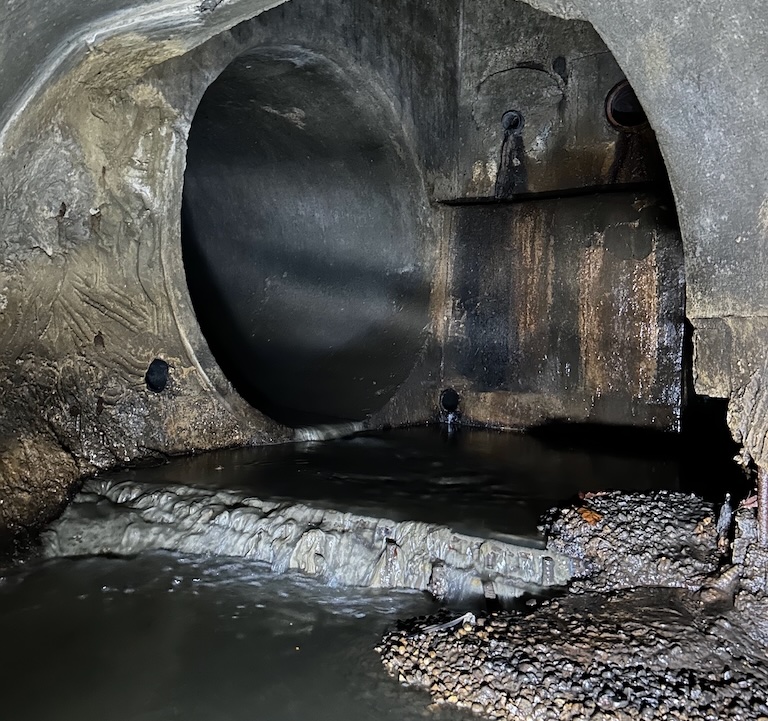
Nathan tells us anecdotal evidence is just as alarming. While wading beneath the streets, this statutory main river ‘smells like an actual sewer’. And even the main Northern Outfall Sewer at Hackney Wick doesn’t compete in terms of how oppressive the odours emanating from Bounds Green Brook have become. And this is before you consider all the runoff forging a route to the water from one of London’s busiest roads, the North Circular. All of which is what his exhibition, The Brook‘, aims to convey.
‘The centrepiece is a new map I’ve made of the Bounds Green Brook catchment. Its title is: Every Brook Flows Into A River and Every River Finds Its Way to the Sea,’ explains Nathan, a graduate of Slade School of Fine Art and the Prince’s Drawing School, and founder of community arts project Pinhole London. ‘[The map] reveals what lies beneath our feet — streams rising on the slopes of the North London Glacial Plateau, flowing into Bounds Green Brook through hidden culverts, spring water polluted by road run-off and sewage misconnections, where untreated waste is flushed into rainwater drains.
‘It’s both a historical document and a contemporary call to action: we deserve clean rivers,’ he continues. ‘Alongside the map I’m showing three large-format photographs that hold the central paradox of this work — the genuine beauty of rising spring water set against the dark reality of what that water becomes as it collects illegal sewage that should never be draining into our river. Then there’s a series of 21 smaller photographs that take you on a journey from the source of Bounds Green Brook — also known as Strawberry Vale Brook — down to where it meets Pymmes Brook. You’ll see scenes most people have no idea exist, even though they drive past them countless times.’
The idea that so few people actually know or understand what is happening on their doorstop, and underfoot, is central to what has inspired Nathan to embark on this endeavour. To him, it’s the devastating outcome of a deliberate effort to make this river invisible. Something that has been repeated in other towns and cities across the UK.
By putting these overlooked rivers back in the spotlight, the public can actually see the extent to which water companies are engaging in environmental crimes and risking public and environmental health. Which is vital in order to put pressure on those firms – in this case Thames Water – to start acting more responsibly.
‘Beyond that, I want to reposition what an artist can be,’ Nathan continues. ‘I see this practice as a form of guardianship — using photography, map-making and drawing to draw attention to the reality of our rivers and demand accountability. Engineers buried this river. I believe artists can make it visible again, and I think that visibility is the first step towards cleaning it up.’
The Brook runs from Wednesday to Sunday from 18th February to Sunday 22nd March (excluding 21st March) at Bruce Castle Museum & Archive, Tottenham, London.
A special artist talk will take place at 3PM on Saturday 14th March – making the International Day of Action for Rivers. You can find full details here.
Top image: (C) Ben Nathan
More Case Studies, Features & Industry Insight:
How to reframe sustainability stories beyond carbon reporting
Hot air, cold response: missed opportunities in UK community energy proposal
Solar carports and EV integration can help UK’s net zero grid