














The facility aims to preserve samples from mountainous regions across the world, helping future scientists understand climate changes.
The facility has been developed by the Ice Memory project, which was launched in 2015 by CBRS, IRD, the University of Grenoble-Alpes (France), CNR, Ca’ Foscari University of Venice (Italy) and the Paul Scherrer Institute (Switzerland). The first of its kind in the world, the initial samples have been transported from Trieste to Antarctica by boat to the Concordia Station, having been taken from endangered Alpine glaciers on Mont Blanc and Grand Combin.
The groundbreaking undertaking has the goal of helping future generations understand the planet’s ice cover through living archives, which will be preserved even with the ongoing heating of the South Pole and its region. Sadly, it is understood that the glaciers from which samples are taken are currently on course to disappear for good.
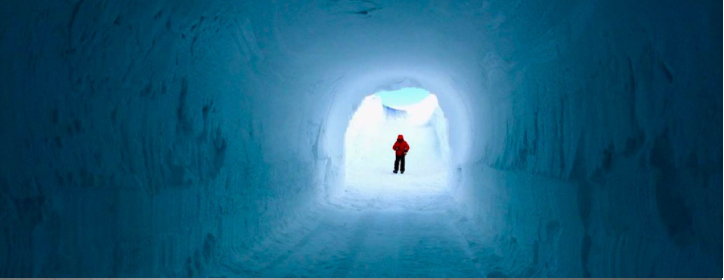
In its current iteration, the Ice Memory Sanctuary is 35 metres long, five metres high and wide, and dug into compact snow to a total of nine metres deep. Construction impact was limited in direct compliance with the Madrid Protocol, needed no materials, foundation or mechanical refrigeration. Temperatures will remain at -52C year round, and archives will be protected from fluctuations in the local environment.
‘By safeguarding physical samples of atmospheric gases, aerosols, pollutants and dust trapped in ice layers, the Ice Memory Foundation ensures that future generations of researchers will be able to study past climate conditions using technologies that may not yet exist,’ explains Carlo Barbante, vice chair of the Ice Memory Foundation, Professor at Ca’ Foscari University of Venice and senior associate member of CNR-ISP.
News of the Sanctuary comes as the University of Toyoma has published a peer-reviewed study of the Thwaites and Pine Island glaciers in the Amundsen Sea, part of the West Antarctic Ice Shelf – known to be the fastest-melting glaciers in the world.
In a bid to improve our understanding of how damaging warmer conditions are to these areas, researchers have been looking at the Pliocene Epoch (between 5.2 and 2.58 million years ago), when global temperatures were 3-4C higher than today.
At this point in history, sea levels were 15 metres above current measures, and it is believed Antarctic ice contributed significant volume to this. As a result, the West Antarctic Ice Shelf had retreated far inland at leas five times.
Image: Ice Cave in Concordia Station © Rocco Ascione PNRA
More on Biodiversity, Climate Change, Nature & Sustainability:
Signs of a sickly planet: Europe’s crop droughts worsen despite rain
Guildford will reveal flood defence scheme design this weekend